
What To Know
- Com, we’ll break down the difference between a one-way and a two-way ANOVA, explain key concepts, and provide practical examples to help you select the appropriate ANOVA for your research design.
- A one-way ANOVA is a statistical test used to determine whether there is a statistically significant difference among the means of three or more groups based on one independent variable.
One Way ANOVA vs Two Way ANOVA: A Complete Guide for Researchers
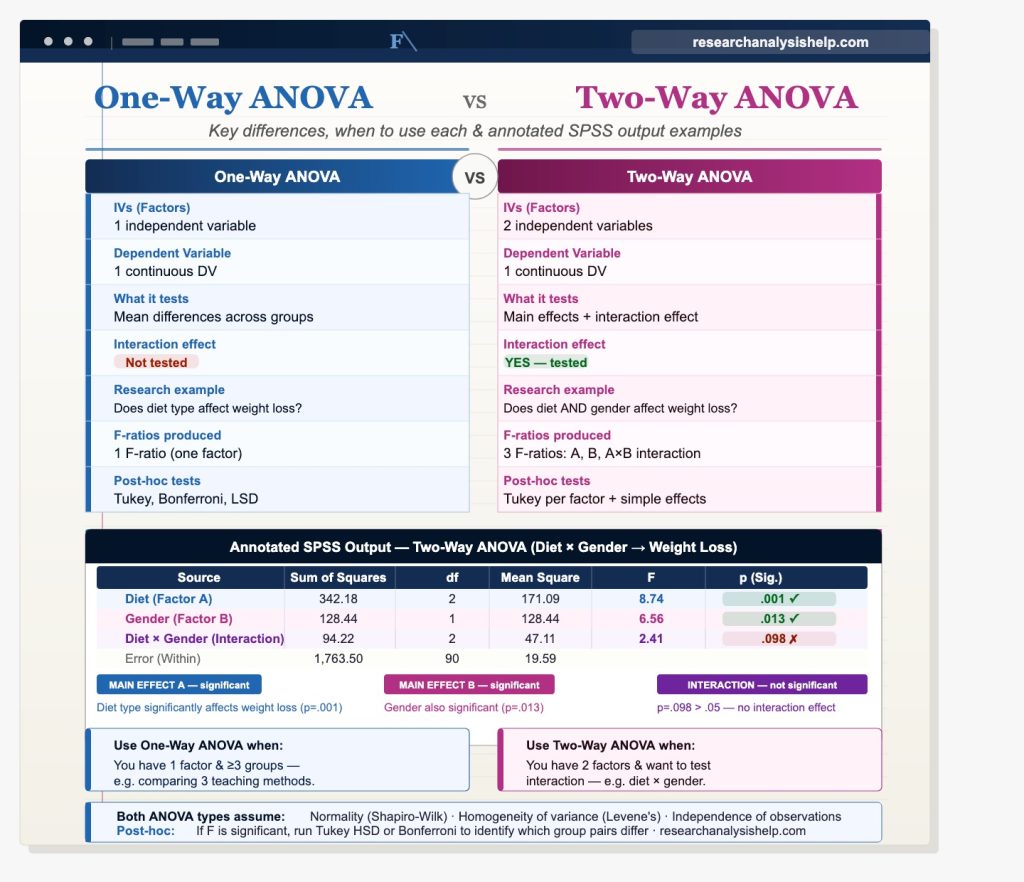
When conducting quantitative research, choosing the right statistical test is essential. One of the most common dilemmas students and researchers face is understanding one way ANOVA vs two way ANOVA. Both are powerful forms of analysis of variance (ANOVA) used to compare group means, but they differ in complexity, purpose, and application.
In this comprehensive guide by ResearchAnalysisHelp.com, we’ll break down the difference between a one-way and a two-way ANOVA, explain key concepts, and provide practical examples to help you select the appropriate ANOVA for your research design.
One-Way ANOVA
A one-way ANOVA is a statistical test used to determine whether there is a statistically significant difference among the means of three or more groups based on one independent variable.
Key Characteristics:
- Also called 1-way ANOVA
- Involves one factor (independent variable)
- The independent variable is categorical
- The dependent variable is one continuous dependent variable (measured at interval or ratio level)
- Used when comparing two or more groups, but especially three or more groups
Example:
A researcher tests whether three different drugs produce different recovery times.
- Independent variable = drug type (categorical independent variable)
- Dependent variable = recovery time
Why Use One-Way ANOVA?
- To compare three or more different group conditions
- When a t-test is used for two groups, ANOVA extends to multiple groups
- Helps examine differences among group means
Statistical Components:
- Sum of squares, degrees of freedom, and variation in the data
- p-value vs critical value determines significance
- If p-value < 0.05 → reject the null hypothesis
- Post-hoc tests identify differences between the means
Assumptions:
- Data is normally distributed
- Homogeneity of variances
- Independence of observations
Two-Way ANOVA
A two way ANOVA is used when there are two independent variables (also called two factors) and one dependent variable.
Key Characteristics:
- Also referred to as 2 way ANOVA
- Includes two categorical independent variables
- Measures effects on one continuous dependent variable
- Allows analysis of interaction effects
Example:
A study examines how teaching method and study time affect exam scores.
- Independent variables = teaching method + study time (two variables)
- Dependent variable = exam score
Why Use Two-Way ANOVA?
- To analyze independent variables on the dependent variable simultaneously
- To detect interaction between two variables
- To examine both main and interaction effects
Key Concepts:
- Interaction effects show whether one variable influences another
- Helps explain variation in the dependent variable
- Often used in factorial ANOVA designs
One-Way ANOVA and Two-Way ANOVA
Understanding one-way ANOVA and two-way ANOVA is crucial for selecting the right statistical analyses.
Core Difference:
- One-way ANOVA → one independent variable
- Two-way ANOVA → two independent variables
Example Comparison:
- One-way: Effect of diet type on weight loss
- Two-way: Effect of diet type and exercise on weight loss
When to Choose:
- Use a one-way ANOVA when studying one factor
- Use two-way ANOVA when examining two factors and their interaction
ANOVA Tests
There are several types of ANOVA tests, each suited for different research scenarios.
Types of ANOVA:
- One-way ANOVA
- Two-way ANOVA
- Factorial ANOVA
- Two-way repeated measures ANOVA
Purpose:
- ANOVA is used to compare the means across groups
- Helps identify differences among group means
- More robust than a t-test, which is used for means of two groups
Important Metrics:
- Sum of squares
- Degrees of freedom
- p-value
- F-statistic
Tools:
- Software like SPSS is widely used for ANOVA analysis
Difference Between One-Way
The difference between one-way ANOVA and other statistical methods lies in its simplicity and focus.
Key Points:
- Uses one independent variable
- Compares one group mean across multiple categories
- Focuses on differences among groups without interaction
Use Case:
- Testing whether different teaching styles produce different outcomes
Two-Way Repeated Measures ANOVA
A two-way repeated measures ANOVA is a more advanced statistical test used when:
- The same subjects are measured multiple times (within a sample)
- There are two independent variables
Example:
Measuring stress levels before, during, and after exams across different study methods
Advantages:
- Controls for variation in the data within subjects
- Reduces impact of unequal sample sizes
- Allows examination of simple main effects
Key Concepts:
- Focus on within each group comparisons
- Helps identify significant interaction
- Used to examine changes over time
Difference Between One-Way ANOVA vs Two-Way ANOVA
Understanding the difference between the two is essential for proper analysis.
Comparison Table:
| Feature | One-Way ANOVA | Two-Way ANOVA |
|---|---|---|
| Number of Independent Variables | One | Two |
| Factors | One factor | Two factors |
| Interaction Effects | Not included | Included |
| Complexity | Simpler | More complex |
| Use Case | Compare three or more groups | Analyze two variables together |
Key Differences:
- The number of independent variables determines the test
- Two-way ANOVA reveals interaction between two factors
- One-way ANOVA only shows differences among group means
One-Way ANOVA vs Two-Way ANOVA in Practice
Scenario 1:
Comparing exam scores across three classrooms
→ Use a one-way ANOVA
Scenario 2:
Comparing exam scores based on classroom and teaching method
→ Use a two-way ANOVA
Scenario 3:
Measuring the same students over time under different conditions
→ Use two-way repeated measures ANOVA
Choosing the Appropriate ANOVA
Selecting the right statistical test used depends on:
1. Research Question
- What are you trying to measure?
- Are there two or more groups?
2. Number of Variables
- One independent variable → one-way ANOVA
- Two independent variables → two-way ANOVA
3. Research Design
- Between-groups → standard ANOVA
- Within-subjects → repeated measures ANOVA
4. Data Requirements
- Dependent variable must be continuous
- Independent variable must be categorical
Key Assumptions in One-Way and Two-Way ANOVA
Both one-way and a two-way ANOVA require:
- Normally distributed data
- Homogeneity of variances
- Independence of observations
Violating these assumptions can affect whether results are statistically significant.
Need Help?
At ResearchAnalysisHelp.com, we specialize in simplifying complex statistical concepts like ANOVA. Whether you’re struggling with selecting the right test or interpreting results, our experts ensure your analysis is accurate, well-structured, and aligned based on the research design.
If you’re working on one-way ANOVA vs two-way ANOVA or related statistical concepts, here are some relevant assignments you can use for practice, coursework, or academic projects:
Related Assignments on ANOVA Topics
1. One-Way ANOVA Assignment
Task:
Conduct a one way ANOVA to determine whether there is a statistically significant difference among the group means of three or more groups.
Example:
- Compare the effectiveness of three different drugs on reducing blood pressure.
- Identify:
- Independent variable (drug type – categorical)
- Dependent variable (blood pressure – continuous)
- Perform:
- Descriptive statistics
- ANOVA analysis
- Interpret p-value, critical value, and degrees of freedom
- Conduct post-hoc tests
2. Two-Way ANOVA Assignment
Task:
Use a two way ANOVA to examine the impact of two independent variables on a dependent variable.
Example:
- Study the effect of teaching method and study time on exam scores.
- Analyze:
- Main and interaction effects
- Whether there is a significant interaction between variables
- Interpret:
- Sum of squares
- variation in the data
- differences among group means
3. One-Way ANOVA vs Two-Way ANOVA Comparison Assignment
Task:
Write a report explaining the difference between one-way and two-way ANOVA.
Include:
- Definitions of:
- One-way ANOVA
- Two-way ANOVA
- Key differences:
- Number of independent variables
- Presence of interaction effects
- Real-world examples
- When to use a one-way ANOVA vs two-way
4. Two-Way Repeated Measures ANOVA Assignment
Task:
Perform a two-way repeated measures ANOVA using data collected within a sample over time.
Example:
- Measure stress levels:
- Before, during, and after exams
- Across different study techniques
Focus on:
- Simple main effects
- Interaction between two variables
- Handling unequal sample sizes
5. ANOVA Using SPSS Assignment
Task:
Conduct ANOVA tests using SPSS.
Steps:
- Input dataset
- Run:
- One-way ANOVA
- Two-way ANOVA
- Check assumptions:
- Normal distribution
- Homogeneity of variances
- Independence of observations
- Interpret output:
- p-value
- F-statistic
- post-hoc results
6. Factorial ANOVA Assignment
Task:
Design a factorial ANOVA experiment with two or more factors.
Example:
- Analyze how diet type and exercise frequency affect weight loss
Include:
- Explanation of interaction effects
- Discussion of variation in the dependent variable
- Interpretation of differences between the means
7. ANOVA vs t-test Assignment
Task:
Compare ANOVA tests with a t-test.
Include:
- When a t-test is used (means of two groups)
- When ANOVA is used (three or more groups)
- Differences in:
- statistical test used
- interpretation of results
8. Research Design Assignment Using ANOVA
Task:
Develop a full research design based on ANOVA.
Include:
- Clear research question
- Identification of:
- Independent variables
- Dependent variable
- Justification of:
- Appropriate ANOVA
- Discussion of:
- sample size
- assumptions
- expected outcomes
Final Tip
These assignments help you understand how ANOVA is used to compare groups, analyze differences among group means, and interpret statistically significant results. Whether you’re working with one factor or two factors, mastering these tasks will strengthen your skills in statistical analyses and research methodology.
Final Thoughts
Understanding one way ANOVA vs two way ANOVA is essential for conducting accurate and meaningful statistical analyses. While both tests are part of ANOVA analysis, the difference between one-way and two-way lies primarily in the number of independent variables and the ability to analyze interaction effects.
Summary:
- One-way ANOVA: Simple, one factor, compares group means
- Two-way ANOVA: More advanced, two factors, includes interaction
- Two-way repeated measures ANOVA: Tracks changes within the same subjects
By aligning your research question, sample size, and research design, you can confidently choose the most appropriate ANOVA and produce statistically sound results.
If you need expert help with SPSS, ANOVA tests, or interpreting p-values and post-hoc results, ResearchAnalysisHelp.com is here to support your academic journey.
Here are clear, expert-backed FAQ answers—crafted in a mix of concise points and explanatory prose—aligned with ResearchAnalysisHelp.com’s approach to statistical clarity and academic support:
FAQs
What is the difference between a one-way ANOVA and a two-way ANOVA?
The difference between a one-way ANOVA and a two-way ANOVA lies primarily in the number of independent variables (factors) and the depth of analysis:
- One-way ANOVA:
- Involves one independent variable
- Used when comparing group means across categories of a single factor
- Focuses on getting different outcomes across groups based on one condition
- Two-way ANOVA:
- Involves two different categorical independent variables
- Examines how different factors simultaneously influence a dependent variable and two independent variables
- Allows analysis based on two variables, including interaction effects
In short, while both are types of ANOVAs, the key distinction is based on the number of variables and whether you want to study combined effects. At ResearchAnalysisHelp.com, we guide students in selecting the right model based on the research design and analytical goals.
When would you use a two-way ANOVA?
A two-way ANOVA is used when your study involves:
- Two different categorical independent variables
- One dependent variable
- A need to analyze how variables interact
Use it when:
- You want to examine outcomes based on two factors (e.g., gender and treatment type)
- You are interested in getting different results not just from each variable individually, but also from their combined effect
- Your analysis requires understanding how different factors influence results together
Example:
If you’re studying how teaching method and study time affect performance, a two-way ANOVA helps you pool the effects and examine both variables simultaneously.
ResearchAnalysisHelp.com ensures accurate application of two-way ANOVA by aligning your analysis based on the research design and data structure.
When to use one-way ANOVA and 2 way ANOVA?
Choosing between one-way and two-way ANOVA depends on your variables and research objectives:
Use One-Way ANOVA when:
- You have one independent variable
- You are comparing three or more groups
- You want to analyze differences based on the number of categories within a single factor
Use Two-Way ANOVA when:
- You have two different categorical independent variables
- You want to explore how different factors influence a dependent variable
- Your study involves analysis based on two variables and their interaction
Key Insight:
The choice is always based on the research design, specifically:
- The number of independent variables
- Whether interaction effects matter
At ResearchAnalysisHelp.com, we help students correctly identify when to apply each of these ANOVAs to ensure valid and meaningful results.
What is the difference between one-way vs two-way ANOVA?
The difference between one-way vs two-way ANOVA can be summarized in both structure and analytical capability:
- One-way ANOVA:
- Simpler design
- Focuses on one factor
- Used for getting different group outcomes based on a single variable
- Two-way ANOVA:
- More advanced
- Incorporates two different categorical variables
- Evaluates both individual and combined (different factors) effects on the outcome
In Practice:
- One-way ANOVA analyzes variation in a dependent variable
- Two-way ANOVA analyzes variation in a dependent variable and two independent variables together
Final Takeaway:
The difference between the two approaches is fundamentally based on the number of variables and whether you need to pool and analyze interaction effects.
Need Help?
At ResearchAnalysisHelp.com, we specialize in simplifying complex statistical concepts like ANOVA. Whether you’re struggling with selecting the right test or interpreting results, our experts ensure your analysis is accurate, well-structured, and aligned based on the research design.