
What To Know
- When data does not meet the assumptions of parametric tests like the t-test, nonparametric statistical methods such as the Mann-Whitney U test (Wilcoxon rank sum test) become essential.
- The Mann-Whitney U test (also written as mann-whitney u-test or u-test) is a statistical test used for comparing two independent samples.
Mann Whitney U Test Wilcoxon Rank Sum: A Complete Guide for Researchers
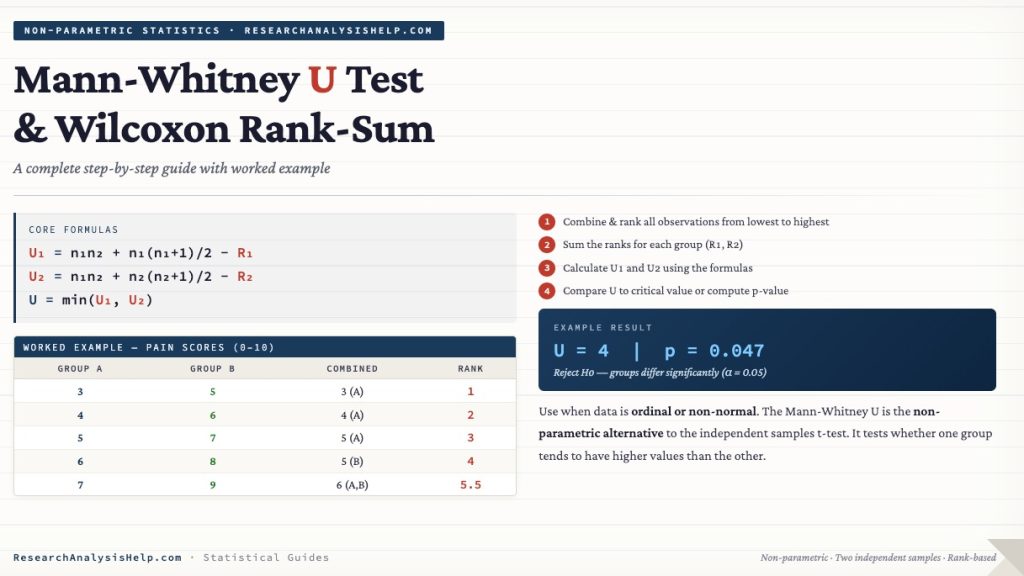
In statistical analysis, researchers often need to compare two groups to determine whether there is a meaningful difference between them. When data does not meet the assumptions of parametric tests like the t-test, nonparametric statistical methods such as the Mann-Whitney U test (Wilcoxon rank sum test) become essential.
This comprehensive guide by ResearchAnalysisHelp.com explains the mann whitney u test wilcoxon rank sum, including definitions, examples, formulas, and when to use this powerful non-parametric test.
Mann-Whitney U
The Mann-Whitney U is a widely used statistical tool designed to compare two independent groups. It is particularly useful when your data is ordinal, skewed, or not normally distributed.
Key Idea:
- Instead of comparing means, it compares ranks in two groups
- Evaluates whether one group tends to have higher values than the other
Example:
Comparing customer satisfaction ratings (ordinal scale) between two companies
Why It Matters:
- Works well for small sample size
- Does not require normal distribution
- A core method in nonparametric methods
Mann-Whitney U Test
The Mann-Whitney U test (also written as mann-whitney u-test or u-test) is a statistical test used for comparing two independent samples.
When to Use:
- You have two independent groups
- Data is not normally distributed
- You are comparing values in the two groups
Steps to Compute:
- Combine both groups into one sample
- Rank all observations
- Calculate the sum of ranks for each group
- Compute the U statistic using the formula
Key Components:
- Sum of the ranks
- U value / value of U
- Test statistic
- Variance and standard deviation (for large samples)
Decision Rule:
- Compare the p-value with 0.05 significance level
- If p < 0.05 → reject the null hypothesis
Two Groups
The Mann-Whitney test focuses on two groups, specifically:
- Two independent groups
- Drawn from two populations
- Observations must be independent (independent samples)
Example:
Comparing test scores of students from two different schools
Important Note:
If the groups are related (dependent samples), use the Wilcoxon signed-rank test instead.
Statistical
From a statistical perspective, the Mann-Whitney test evaluates:
- The difference in medians
- Whether one group has consistently higher or lower ranks
Hypotheses:
- Null hypothesis: No difference between the two populations
- Alternative hypothesis: A difference exists (difference in medians)
This makes it a strong alternative to the samples t-test when assumptions are violated.
Approximation
For larger sample sizes, the test uses a normal distribution approximation.
Why Approximation?
- Exact calculation becomes complex with large datasets
- The U statistic is converted into a z-score
Includes:
- Mean and variance of U
- Standardization using standard deviation
This allows quick computation using a calculator or statistical software.
Wilcoxon
The test is closely related to Wilcoxon methods, particularly:
- Wilcoxon rank-sum test (same as Mann-Whitney U)
- Wilcoxon signed-rank test (for dependent samples)
Key Difference:
- Rank-sum → two independent groups
- Signed-rank → dependent samples
Distribution
Unlike parametric tests, the Mann-Whitney test does not assume a normal distribution.
Instead:
- It uses rank-based distribution
- Falls under nonparametric statistical methods
Comparison:
- Parametric: assumes normality (e.g., t-test)
- Non-parametric: flexible, fewer assumptions
Statistic
The core output of the test is the U statistic.
What is the U Statistic?
- A measure of how ranks differ between groups
- Represents the number of times observations in one group precede the other
Interpretation:
- Smaller U → greater difference between groups
- Compared against critical values or converted to p-value
Nonparametric
The Mann-Whitney test is a nonparametric (or non-parametric test) method.
Advantages:
- No assumption of normality
- Suitable for ordinal data
- Robust against outliers
Common in:
- Social science
- Medical research
- Behavioral studies
Sum
A critical part of the test involves calculating the sum of ranks.
Process:
- Assign ranks to all values
- Compute sum of the ranks for each group
Purpose:
- Determines how data points are distributed across groups
- Forms the basis for calculating the U value
Wilcoxon Rank Sum Test
The Wilcoxon rank sum test is another name for the Mann-Whitney U test.
Why Two Names?
- Developed independently by Wilcoxon and Mann & Whitney
Use Case:
- Comparing two independent samples
- Identifying difference in medians
U Statistic
The U statistic is central to the test.
Formula-Based:
- Derived from sum of ranks
- Adjusted for sample size
Output:
- Mann-Whitney U value
- Compared with critical tables or converted into p-value
Median
Unlike the t-test, which compares means, this test focuses on the median.
Why Median?
- More robust for skewed data
- Better for ordinal variables
Mann-Whitney U-Test
The mann-whitney u-test is widely used as an alternative to:
- Samples t-test
- Sign test
- Kolmogorov-Smirnov test
When to Prefer It:
- Small sample size
- Non-normal data
- Unequal variances
Test Statistic
The test statistic in this method is the U value.
Steps:
- Calculate sum of ranks
- Compute U statistic
- Compare with critical values or derive p-value
Nonparametric Methods
The Mann-Whitney test belongs to broader nonparametric methods.
Other Methods Include:
- Wilcoxon signed-rank test
- Sign test
- Kolmogorov-Smirnov test
These methods are essential when assumptions of parametric tests fail.
U-Test
The U-test is another shorthand for the Mann-Whitney test.
Key Benefit:
- Simple yet powerful for comparing two groups
Comparing Two
At its core, this test is about comparing two independent samples.
Applications:
- Comparing treatment vs control groups
- Evaluating performance differences
- Measuring outcomes across two populations
Advanced Insight:
- Can relate to metrics like area under the ROC curve in classification problems
Nonparametric Statistical Methods
The Mann-Whitney U test is one of the most widely used nonparametric statistical methods.
Why Researchers Prefer It:
- Flexible
- Reliable for real-world data
- Works well with small samples and skewed distributions
Get Expert Help with Your Statistical Analysis Today
Struggling with concepts like the Mann-Whitney U test, Wilcoxon rank-sum test, or other nonparametric statistical methods? Don’t let confusion hold back your academic success.
Here are relevant assignments you can use for coursework, practice, or research projects related to the Mann Whitney U Test (Wilcoxon Rank Sum Test):
1. Mann-Whitney U Test Assignment
Task:
Perform a mann-whitney u-test to compare two independent groups and determine whether there is a difference in medians.
Example:
- Compare customer satisfaction scores between two companies
- Identify:
- Independent samples (two groups)
- Ordinal or non-normal data
- Compute:
- Sum of ranks
- U statistic (value of U / u value)
- Interpret:
- p-value at 0.05 significance level
- Whether to reject the null hypothesis
2. Wilcoxon Rank Sum Test Assignment
Task:
Use the Wilcoxon rank-sum test to analyze differences between two populations.
Requirements:
- Rank all observations across groups
- Calculate sum of the ranks for each group
- Determine the test statistic
- Explain results in terms of statistical significance
Focus:
- Understanding ranks in two groups
- Interpreting difference in medians
3. Mann-Whitney U vs t-test Assignment
Task:
Compare the Mann-Whitney U test with a samples t-test.
Include:
- When to use each statistical test
- Assumptions:
- Normal distribution vs non-parametric
- Differences in:
- Mean vs median
- Standard deviation vs rank-based analysis
Goal:
Explain why the mann-whitney u-test is preferred under nonparametric methods.
4. Two Sample Nonparametric Test Assignment
Task:
Analyze a two sample dataset using nonparametric statistical methods.
Steps:
- Define null hypothesis and alternative hypothesis
- Use u-test to compare values in the two groups
- Compute:
- Variance
- approximation (for large sample size)
- Interpret results using statistical reasoning
5. Wilcoxon vs Signed-Rank Test Assignment
Task:
Differentiate between:
- Wilcoxon rank sum test (independent samples)
- Wilcoxon signed-rank test (dependent samples)
Include:
- Examples of:
- Two independent groups
- Dependent samples
- Explain:
- When to use each test
- Role of signed rank
6. Manual Calculation of Mann-Whitney U Assignment
Task:
Manually compute the mann-whitney u value.
Instructions:
- Combine both groups into one dataset
- Assign ranks
- Calculate:
- Sum of ranks
- U statistic
- Verify results using a calculator or software
7. Nonparametric Methods in Social Science Assignment
Task:
Apply nonparametric methods in a social science context.
Example:
- Compare stress levels between two professions
Focus on:
- Why data is non-parametric
- Use of rank test
- Interpretation of statistical test results
8. Hypothesis Testing with Mann-Whitney Assignment
Task:
Conduct full hypothesis testing using the mann whitney u test.
Include:
- Define:
- Null hypothesis
- Alternative hypothesis
- Perform test
- Use p-value and u statistic
- Decide whether to reject the null hypothesis
9. Mann-Whitney and ROC Analysis Assignment
Task:
Explore the relationship between the Mann-Whitney U test and area under the ROC curve.
Focus:
- Interpretation of ranking performance
- Link between u statistic and classification accuracy
10. SPSS-Based Mann-Whitney Assignment
Task:
Run a wilcoxon test / mann-whitney u-test in SPSS.
Steps:
- Input data
- Select appropriate non-parametric test
- Interpret output:
- U value
- significance level
- test statistic
Final Tip
These assignments help you master comparing two independent groups using nonparametric statistical methods. You’ll gain practical experience in calculating the sum of ranks, interpreting the U statistic, and understanding when to use the Mann-Whitney test instead of parametric alternatives.
Final Thoughts
The mann whitney u test wilcoxon rank sum is an essential statistical test for researchers working with two independent groups and non-normal data. By focusing on ranks in two groups rather than raw values, it provides a robust and flexible alternative to parametric tests.
Key Takeaways:
- Ideal for non-parametric data
- Compares difference in medians
- Uses U statistic and sum of ranks
- Works well across various fields, especially social science
If you need help performing the Mann-Whitney U test, interpreting the U value, or using tools like SPSS or a calculator, ResearchAnalysisHelp.com offers expert support to ensure accurate and reliable statistical results.
FAQs
Here are expertly crafted FAQ answers—blending clear bullet points with explanatory prose—positioned to highlight the value of ResearchAnalysisHelp.com:
Are Mann-Whitney U and Wilcoxon rank sum the same?
Yes—the Mann-Whitney U test and the Wilcoxon rank-sum test are essentially the same statistical method, just presented with different names and slightly different calculation approaches.
- Both are nonparametric statistical tests
- Both are used for comparing two independent groups
- Both rely on ranking the data rather than raw values
- The difference lies mainly in the test statistic reported:
- Mann-Whitney reports the U statistic
- Wilcoxon rank-sum reports the sum of ranks (W statistic)
In practice, they lead to the same conclusion about statistical significance. At ResearchAnalysisHelp.com, we help you understand both interpretations and apply the correct one depending on your software (e.g., SPSS, R) or academic requirements.
What is the Wilcoxon rank-sum test used for?
The Wilcoxon rank-sum test is used to determine whether there is a statistically significant difference between two independent groups, especially when the data does not meet parametric assumptions.
It is commonly used when:
- Data is not normally distributed
- The variable is ordinal or skewed
- You want to compare medians instead of means
In simple terms:
It answers the question:
Are the values in one group generally higher or lower than those in another?
Example:
- Comparing customer satisfaction ratings between two brands
- Evaluating test scores from two different teaching methods
At ResearchAnalysisHelp.com, we guide students step-by-step—from ranking data to interpreting p-values—ensuring accurate and confident use of this test.
What is the Wilcoxon Mann Whitney WMW rank-sum test?
The Wilcoxon Mann Whitney (WMW) rank-sum test is simply a combined name referring to the same nonparametric test developed independently by Wilcoxon and Mann & Whitney.
Key Points:
- “WMW” stands for Wilcoxon–Mann–Whitney
- It is a rank-based statistical test
- Used for two independent samples
- Tests whether the two populations differ in distribution or median
Why multiple names?
- Wilcoxon introduced the rank-sum concept
- Mann & Whitney formalized the U statistic approach
Despite naming differences, it is one unified method widely used in social science, healthcare, and business research.
With ResearchAnalysisHelp.com, you don’t just learn the definitions—you gain clarity on when and how to apply the test correctly in real assignments and research.
When to use Wilcoxon and Mann-Whitney?
Choosing between Wilcoxon and Mann-Whitney depends on your data type and research design, but remember—they are closely related methods.
Use Mann-Whitney / Wilcoxon Rank-Sum Test when:
- You are comparing two independent groups
- Data is non-parametric (not normally distributed)
- You are analyzing ordinal or skewed data
- You want to test for differences in medians or distributions
Use Wilcoxon Signed-Rank Test when:
- You have dependent samples (e.g., before vs after study)
- The same participants are measured twice
Quick Rule:
- Independent groups → Mann-Whitney / Rank-Sum
- Dependent samples → Signed-Rank
Example:
- Independent: Comparing two teaching methods → Mann-Whitney
- Dependent: Measuring student improvement over time → Wilcoxon signed-rank
At ResearchAnalysisHelp.com, we help you confidently choose the right test based on your dataset, assumptions, and research goals, ensuring your statistical analysis is both accurate and academically sound.
Need Expert Help?
Whether you’re confused about nonparametric tests, struggling with calculations, or interpreting results, ResearchAnalysisHelp.com provides:
- ✔️ Step-by-step solutions
- ✔️ SPSS/R guidance
- ✔️ Assignment support
Get clarity, accuracy, and better grades with expert assistance.