
What To Know
- Data analysis is the process of inspecting, cleaning, transforming, and modeling data to discover useful information and support data for decision-making.
- A powerful data visualization tool that helps users visualize data and create data visualizations from data stored in databases.
Data Analysis Tools: The Complete Guide to Turning Raw Data into Actionable Insights
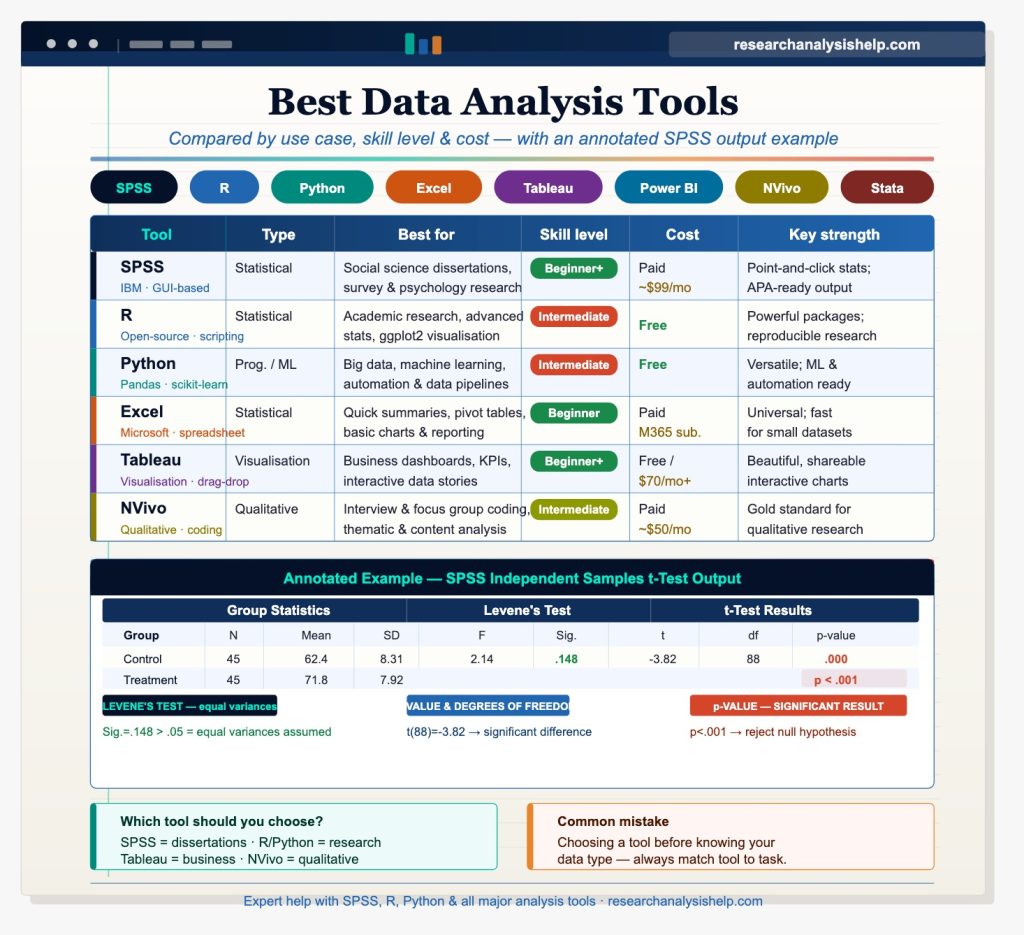
In the modern world of data, organizations rely heavily on data analysis tools to make smarter, faster, and more accurate decisions. From small startups to global enterprises, the ability to analyze data, manage large amounts of data, and generate insights is no longer optional—it’s essential.
But what exactly are data analysis tools, and how do they work?
This guide explores everything you need to know about data analysis tools, including definitions, examples, and how they help transform raw data into meaningful and actionable insights.
Data Analysis: How Businesses Use Data Across Systems
Data analysis is the process of inspecting, cleaning, transforming, and modeling data to discover useful information and support data for decision-making.
Organizations today collect data across multiple systems, including:
- CRM platforms
- Google Analytics and web tracking tools
- Internal databases and data warehouses
- Live data sources and real-time applications
This means businesses must handle data from various sources, including structured and unstructured data, to uncover data patterns and trends.
For example, a retail company may combine business data, website traffic, and customer feedback to better understand purchasing behavior.
Data Analysis Tool: What It Is and Why It Matters
A data analysis tool is software designed to help users work with data, process it, and generate insights. In fact, data analysis tools are software that simplify complex processes like data cleaning, data manipulation, and data processing.
These tools allow users to:
- Handle complex data and large-scale data
- Perform querying of data stored in databases
- Explore data sets and generate reports
A good tool for data analysis helps solve data problems, whether you’re working with manual data, existing data, or newly collected datasets.
15 Data Analysis Tools You Should Know
Choosing the right data analysis tools is essential for turning raw data into meaningful insights. Below are 15 powerful data analysis tools used by data professionals, data scientists, and businesses to analyze data, handle large amounts of data, and support better decision-making.
1. Python
Python is a programming language widely used in data science, data analytics, and software and web development. It supports data manipulation, data processing, and advanced modeling.
Best for: Handling complex data, automation, and predictive analytics.
2. Excel
Excel remains one of the most popular data analysis tools for working with business data and manual data.
Best for: Basic statistical analysis, data cleaning, and quick reporting.
3. Google Analytics
A leading analytics platform that tracks website performance using real-time data and live data sources.
Best for: Marketing insights and understanding user behavior from google data.
4. Tableau
A powerful data visualization tool that helps users visualize data and create data visualizations from data stored in databases.
Best for: Interactive dashboards and storytelling.
5. Power BI
Microsoft’s data analytics platform for building BI dashboards and interactive visualizations.
Best for: Business reporting and data for decision-making.
6. R Programming
An open-source tool used in the field of data analytics for statistical analysis and data exploration.
Best for: Advanced statistics and academic research.
7. Apache Spark
A big data tool designed for processing large-scale data and big data efficiently.
Best for: Handling large amounts of data and real-time analytics.
8. SAS
A leading statistical analysis software used by enterprises for data management and advanced analytics.
Best for: Enterprise-level analytics and regulated industries.
9. SPSS
A popular tool for statistical analysis used in research and academia.
Best for: Surveys, hypothesis testing, and quantitative research.
10. RapidMiner
A data analytics tool that supports data mining, data modeling, and machine learning workflows.
Best for: End-to-end analytics without heavy coding.
11. KNIME
An open-source analytics tool that allows users to combine data, build workflows, and automate processes.
Best for: Data integration and visual workflows.
12. Qlik Sense
A modern data visualization tool with strong data exploration capabilities.
Best for: Discovering data patterns and trends across various data.
13. Google Data Studio (Looker Studio)
A free data visualization tool that integrates with google analytics and other data sources.
Best for: Creating shareable reports and dashboards.
14. Minitab
A statistical tool used for regression analysis, quality improvement, and data processing.
Best for: Manufacturing and quality control analytics.
15. Microsoft Fabric
An advanced data analytics platform that combines data warehouse, data integration, and analytics in one place.
Best for: Managing data across multiple systems and large-scale data environments.
Get Expert Help with Your Data Today
Ready to turn your data into powerful insights? At ResearchAnalysisHelp.com, we go beyond basic analysis—using advanced tools like Python, Excel, and AI-driven platforms to work with your data using proven methods that deliver real results.
These 15 powerful data analysis tools help organizations transform raw data into meaningful insights. Whether you need to work with data, perform data cleaning, or build complex data models, the right tool for data analysis can solve your data problems and unlock valuable insights.
From Excel and Python to enterprise-grade platforms like Power BI and Microsoft Fabric, each tool plays a vital role in the modern world of data.
Analytics & AI: How AI Data is Transforming Data Analytics
Modern analytics is powered by AI, making it easier to process big data and extract insights. With using AI, organizations can automate tasks and uncover patterns that traditional methods may miss.
An AI data analyst can:
- Process large amounts of data in seconds
- Detect anomalies in regulated data
- Perform advanced data mining and network analysis
For example, financial institutions use AI data systems to detect fraud by analyzing real-time data and identifying unusual behavior patterns.
Data Analytics: Turning Data into Actionable Insights
Data analytics focuses on examining datasets to draw conclusions and support decisions. It involves collecting, processing, and interpreting various data to generate insights.
With the help of data analytics platforms, organizations can:
- Combine many data sources into a unified system
- Perform data exploration and uncover trends
- Convert data into actionable insights
For instance, a marketing team might analyze google data to understand campaign performance and optimize strategies.
Python: A Powerful Data Science Programming Language
Python is a programming language widely used in the field of data analytics, data science, and software and web development.
Why Python is essential:
- Supports data manipulation and data processing
- Enables regression analysis and predictive modeling
- Works with open-source data and large datasets
Data science teams use Python to:
- Build complex data models
- Automate workflows
- Analyze large-scale data efficiently
For example, analysts use Python libraries like Pandas and NumPy to clean data, combine datasets, and extract insights.
Visualization Tool: How to Visualize Data Effectively
A visualization tool helps users visualize data through charts, graphs, and dashboards. It’s a key part of data analytics and visualization.
These tools allow you to:
- Create data visualizations from complex datasets
- Present insights clearly
- Help stakeholders explore data easily
Examples of data visualization tools include:
- Tableau
- Power BI
- Excel dashboards
Using these tools, businesses can data and create visualizations that make even complex data models easy to understand.
Analytics Tools: Popular Software for Data Professionals
There are many analytics tools available, each designed for specific needs in the field of data analytics.
Popular tools include:
- Excel for basic analysis and reporting
- Python for advanced analytics
- Google Analytics for web insights
- Statistical analysis software like SPSS
These data tools help data professionals handle a wide range of data, from small datasets to big data.
Data Analytics Tool & Data Analytics Platform: Managing Big Data
A data analytics tool is often part of a larger data analytics platform that supports data integration, storage, and processing.
These platforms:
- Store data stored in databases
- Enable data management and data warehouse solutions
- Process large amounts of data in real time
For example, a logistics company might upload data from multiple systems and use a platform to optimize delivery operations.
Data Science & Predictive Analytics: Forecasting Trends
Data science combines statistics, programming, and domain knowledge to extract insights from data. One of its key components is predictive analytics.
Predictive analytics uses:
- Regression analysis
- Historical data sets
- Machine learning models
Businesses use it to:
- Forecast demand
- Identify risks
- Improve customer experiences
For example, streaming platforms use predictive analytics to recommend content based on user behavior.
15 Data Insights: How Organizations Use Data for Growth
Organizations rely on insights derived from 15 data-driven approaches to improve performance. These insights come from analyzing:
- Customer behavior
- Sales performance
- Operational efficiency
Each insight is derived from combining specific data, existing data, and new data to create a complete picture.
15 Powerful Data Techniques to Transform Raw Data
Here are 15 powerful data techniques used by modern organizations:
- Data cleaning to ensure accuracy
- Data integration to combine datasets
- Data mining for hidden patterns
- Regression analysis for forecasting
- Network analysis for relationships
- Data exploration to understand trends
- Data manipulation for structuring data
- Data processing for scalability
- Querying of data for insights
- Visualization for communication
- Predictive analytics for future trends
- AI-driven analytics for automation
- Data modeling for structure
- Real-time data analysis for quick decisions
- Data management for governance
These methods help transform raw data into insights that drive success.
Uses Data Across Industries: From Raw Data to Decision-Making
Every industry uses data to improve performance. From healthcare to finance, organizations rely on data analysis tools to handle large amounts of data and generate insights.
Key benefits include:
- Better data for decision-making
- Improved efficiency
- Faster access to insights
Whether working with manual data, regulated data, or big data, the right tools make it easier to access data, process it, and act on it.
Conclusion: Why Data Analysis Tools Are Essential
In today’s data-driven world, the ability to analyze data, manage complex data, and generate insights is critical.
With the help of:
- Advanced analytics tools
- AI-powered solutions
- Skilled data scientists and analysts
organizations can transform raw data into meaningful insights and stay competitive.
Data analysis tools are not just software—they are the foundation of modern decision-making, enabling businesses to unlock the full potential of their data.
Here are well-structured FAQ answers tailored for ResearchAnalysisHelp.com, written to be informative while subtly positioning your service as the expert solution:
FAQs
What are the 4 types of data analysis?
The four main types of data analysis are:
- Descriptive Analysis
Focuses on summarizing historical data to understand what has happened. This is often the first step where analysts include data from various sources to generate reports and dashboards. - Diagnostic Analysis
Goes deeper to explain why something happened. It helps uncover patterns and relationships by working with part of the data to identify root causes. - Predictive Analysis
Uses historical data using statistical models and machine learning to forecast future outcomes. This is widely used in business for trend prediction. - Prescriptive Analysis
Recommends actions based on insights. It combines analytics with decision-making tools to provide clear strategies.
At ResearchAnalysisHelp.com, we apply all four types to deliver complete insights into their data, ensuring clients not only understand their data but also know how to act on it.
What are the top 10 analytics tools?
There are many powerful analytics tools, but the top 10 commonly used include:
- Python
- Excel
- Power BI
- Tableau
- Google Analytics
- R Programming
- SPSS
- SAS
- Apache Spark
- Microsoft Fabric
These tools like Python and Power BI allow analysts to process, visualize, and interpret data using advanced techniques.
However, tools alone are not enough. At ResearchAnalysisHelp.com, we combine the right tools like these with expert analysis to provide deeper insights into their data, tailored to specific research or business needs.
Is MS Excel a tool for data analysis?
Yes, MS Excel is a powerful and widely used tool for data analysis.
- It allows users to organize, clean, and include data from multiple sources
- Supports formulas, pivot tables, and charts to analyze data
- Helps create basic dashboards and reports
Excel is especially useful for working with part of the data in smaller datasets and for quick analysis tasks.
However, for large amounts of data or advanced analytics, professionals often combine Excel with tools like Python or Power BI. At ResearchAnalysisHelp.com, we use Excel alongside advanced platforms to deliver more comprehensive insights into their data.
What are the top 3 skills for a data analyst?
The top three essential skills for a data analyst are:
- Analytical & Statistical Skills
The ability to interpret numbers, identify trends, and work with data using statistical methods to generate meaningful results. - Technical Skills (Tools & Programming)
Proficiency in tools like Excel, Python, SQL, and visualization platforms. These help analysts process and include data from different sources efficiently. - Data Visualization & Communication
The ability to present findings clearly and provide insights into their data so stakeholders can make informed decisions.
At ResearchAnalysisHelp.com, our experts combine these skills to ensure every dataset—whether small or complex—is analyzed effectively, even when working with just part of the data or integrating multiple data sources.