

What To Know
- Com, we specialize in offering comprehensive statistical analysis help to assist students and researchers in making sense of their data and research findings.
- Whether you’re conducting quantitative research, performing hypothesis testing, or analyzing business data, our expert team of statisticians is here to provide the support you need to make informed decisions based on reliable statistical methods.
Professional Statistical Analysis Help
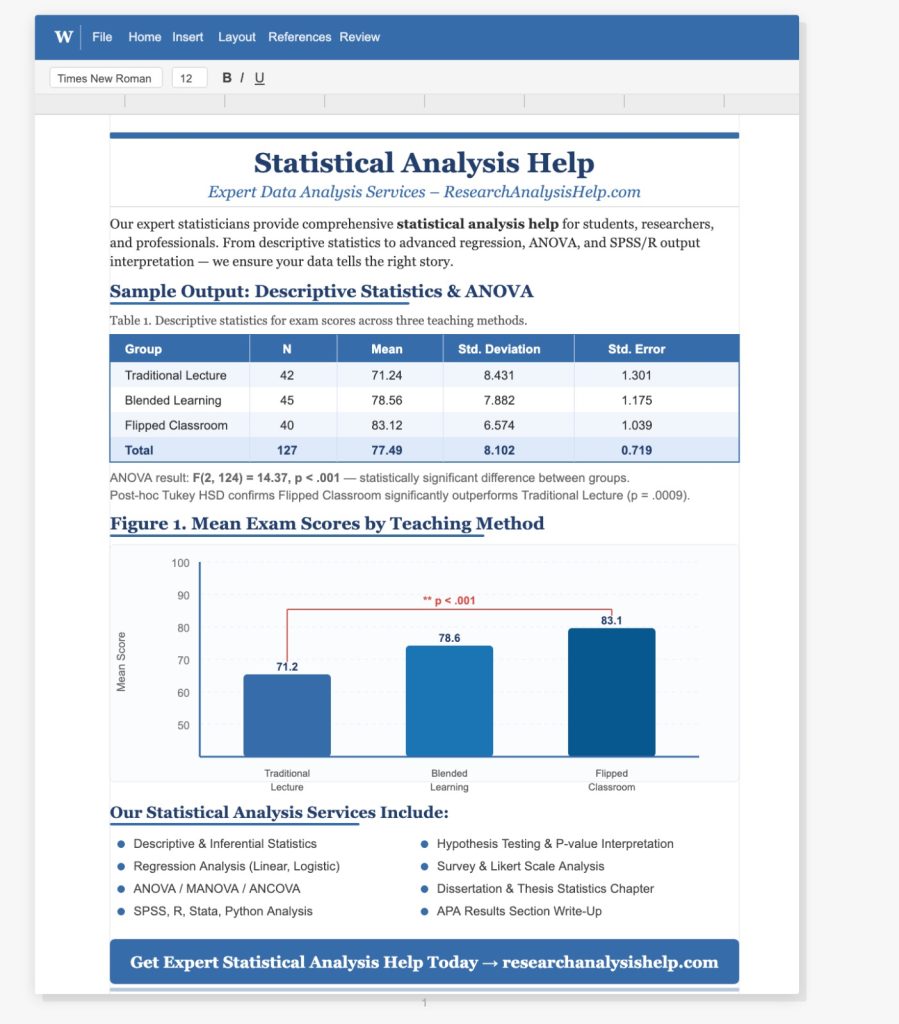
At ResearchAnalysisHelp.com, we specialize in offering comprehensive statistical analysis help to assist students and researchers in making sense of their data and research findings. Whether you’re conducting quantitative research, performing hypothesis testing, or analyzing business data, our expert team of statisticians is here to provide the support you need to make informed decisions based on reliable statistical methods.
Our services cover a wide range of statistical analyses, from basic descriptive statistics to advanced inferential statistics. Whether you’re working with raw data, need help with regression models, or want guidance using SPSS, we are equipped to help you understand the statistical significance of your findings.
Understanding Statistical Analysis
Statistical analysis is a process of collecting, organizing, and interpreting data to reveal patterns, relationships, and trends that inform decision-making. It involves the use of various statistical methods to analyze quantitative data, which can then be used to support research design, verify hypotheses, or explore relationships between variables.
Key Types of Statistical Analyses
- Descriptive Statistics: These are basic statistical tools used to summarize and describe the essential characteristics of a dataset. Common methods include calculating measures of central tendency (mean, median, mode) and variability (standard deviation, range).
- Inferential Statistics: This branch of statistics goes beyond describing data; it helps you infer conclusions about a population based on sample data. Key concepts include hypothesis testing, confidence intervals, and the p-value.
- Regression Analysis: A technique used to understand relationships between variables. Linear regression models, for example, help predict the value of a dependent variable based on one or more independent variables. This is often used in both academic and business contexts to predict trends or outcomes.
- Statistical Tests: These tests assess whether there are significant differences between groups or associations between variables. Common tests include t-tests, ANOVA, and Chi-square tests.
Examples of Our Statistical Analysis Services
- Descriptive Analysis:
- We use tools like SPSS, Stata, and Excel to calculate key descriptive statistics such as means, medians, modes, and standard deviations to summarize your dataset.
- Regression Models:
- Our experts help with linear regression, logistic regression, and other advanced regression models to analyze how changes in one or more predictor variables impact your dependent variable.
- Hypothesis Testing:
- We guide you through the process of hypothesis testing, helping you reject the null hypothesis and determine statistical significance. This includes selecting the right statistical test, such as a t-test or ANOVA, depending on your research question and data type.
- Inferential Analysis:
- We apply inferential statistics to draw conclusions about a population of interest based on a sample. This involves calculating confidence intervals, effect size, and p-values to understand the robustness of your findings.
Our Expertise in Statistical Software
We are proficient in the use of several statistical software packages, providing flexibility depending on the tools that best suit your needs.
- SPSS: We assist with various SPSS tasks, from data cleaning and data entry to running complex statistical analyses such as regression models and ANOVA.
- Stata: This software is widely used in clinical research, and we offer support in performing descriptive and inferential analysis, particularly for large datasets.
- Excel: For simpler analyses, we can guide you through the use of Excel to perform basic statistical methods, like creating graphs and calculating averages or standard deviations.
Data Collection and Data Cleaning
Effective data collection and data cleaning are essential for the success of any statistical analysis. Our team can help you collect and organize raw data into a usable format, removing inconsistencies or outliers that may skew your results.
We specialize in cleaning datasets to ensure that the data is ready for analysis. This includes handling missing values, transforming variables to meet level of measurement requirements, and addressing categorical variables for statistical testing.
Statistical Analysis in Business
Our statistical analysis in business services provide companies with the tools to optimize decision-making. By analyzing quantitative data, we help businesses identify market trends, assess product performance, and forecast future growth.
- Regression Analysis: Businesses use regression models to forecast sales, predict customer behavior, and evaluate marketing campaign effectiveness.
- Predictor Variables: By understanding the relationship between predictor variables (like advertising spend) and dependent variables (like sales), businesses can optimize their strategies for better performance.
- Statistical Evidence: We provide statistical evidence to support business decisions, helping companies make data-driven choices.
How We Help Students and Researchers
We understand that statistical analysis can be challenging, especially for students and researchers who may not be familiar with advanced techniques. That’s why we offer tailored statistics help and research consulting to guide you through the complexities of quantitative research. Our services are designed to help students succeed in their research projects, whether they are writing a thesis, analyzing survey results, or conducting experiments.
- Research Design: We help students develop a robust research design, ensuring that the right statistical methods and sample size are chosen to answer the research question effectively.
- Data Analysis: Our team helps analyze quantitative data using the most appropriate statistical tests and techniques, including t-tests, linear regression, and logistic regression.
- Interpretation and Summary: Once your analysis is complete, we assist with the interpretation of results, ensuring that you can write a comprehensive summary of your findings, including statistical significance, coefficients, and effect size.
Learn Statistical Analysis
Whether you’re looking to learn statistical analysis for academic purposes or want to improve your data skills for business, we offer resources and consulting to help you gain a deeper understanding of statistics and its applications. We provide step-by-step guidance on how to approach statistical tests, use statistical software, and interpret output.
Research Consulting for Precision and Accuracy
Our research consulting services offer expert guidance throughout your research journey. Whether you’re designing a new study or analyzing data, we provide the strategic direction and statistical help needed to ensure that your research is both valid and impactful.
Here are some related assignments that could benefit from statistical analysis help and involve using SPSS, SAS, or other statistical software:
1. Data Analysis for Research Projects
Assignment Overview:
You are tasked with conducting data analysis for a research project using quantitative research methods. This includes designing your study, collecting data, performing appropriate statistical tests (such as t-tests, ANOVA, or regression), and interpreting the results to make data-driven decisions.
Key Tasks:
- Develop a clear analysis plan based on your research question.
- Use SPSS or SAS to perform statistical tests such as hypothesis testing or regression analysis.
- Clean and organize your data to ensure valid results.
- Visualize key findings using charts and graphs to support conclusions.
2. Business Performance Analysis Using Regression Models
Assignment Overview:
Analyze business data to evaluate the relationship between variables. Using regression models (such as linear regression or logistic regression), you will explore the influence of predictor variables (e.g., advertising spend, customer reviews) on key performance metrics (e.g., sales, market share).
Key Tasks:
- Choose variables of interest and set up your study design.
- Collect and clean the data before applying regression analysis.
- Analyze the coefficients and significance to understand the relationship between variables.
- Interpret the p-value, variance, and any statistically significant results.
3. Hypothesis Testing for Academic Research
Assignment Overview:
Perform hypothesis testing for a research paper or project to test the validity of a null hypothesis. This could involve comparing group means, testing relationships between variables, or assessing proportions.
Key Tasks:
- Define your null hypothesis and alternative hypothesis.
- Select an appropriate statistical test (e.g., t-test, ANOVA, Chi-square) based on the types of variables in your dataset.
- Collect data and clean it for analysis, ensuring you meet the assumptions for the chosen test.
- Run the test using SPSS or another statistical software and interpret the results to either reject or fail to reject the null hypothesis.
4. Exploring Variance in Experimental Research
Assignment Overview:
Use ANOVA to analyze data from an experimental research study. The objective is to determine if there are any statistically significant differences in means across multiple groups. For example, this could apply to evaluating the effectiveness of different treatment methods in a clinical trial.
Key Tasks:
- Formulate your research question and define the variable types (e.g., categorical independent variables, continuous dependent variables).
- Collect and clean data, ensuring proper preparation for running the ANOVA test.
- Interpret the variance, effect size, and statistical significance of the results.
- Create visualizations such as boxplots or bar charts to display group differences.
5. Business Data and Forecasting Using Statistical Models
Assignment Overview:
Use statistical methods to analyze and forecast business performance. This could involve time-series analysis, predictive modeling, or regression analysis to make data-driven predictions for future business decisions.
Key Tasks:
- Define the predictor variables and the dependent variable.
- Choose the appropriate model (e.g., linear regression, machine learning models for prediction).
- Collect data, clean it, and run the analysis using statistical software.
- Interpret the coefficients and statistical significance, and evaluate the predictive accuracy of your model.
6. Statistical Analysis for Clinical Research
Assignment Overview:
In clinical research, you may need to analyze patient data to determine the efficacy of treatments or drugs. Using inferential statistics and regression analysis, this assignment involves testing hypotheses, evaluating treatment effects, and making conclusions based on data.
Key Tasks:
- Define the hypotheses related to treatment efficacy.
- Use regression models or t-tests to analyze differences between treatment groups.
- Analyze data for statistical significance, including evaluating the effect size and confidence intervals.
- Interpret results in the context of clinical outcomes, providing actionable insights for decision-making.
7. Exploratory Data Analysis and Visualization
Assignment Overview:
Perform an exploratory data analysis (EDA) on a large dataset to understand patterns and insights before proceeding to more complex analyses. This could involve descriptive statistics, visualization, and basic statistical tests to uncover trends in the data.
Key Tasks:
- Conduct basic statistical analysis like mean, median, variance, and standard deviation to summarize the data.
- Use visualization tools (histograms, scatter plots) to represent relationships between variables.
- Identify potential patterns and prepare an analysis plan for further, more specific tests (e.g., regression analysis).
These assignments involve a combination of statistical methods, data collection, data cleaning, and the application of statistical software (SPSS, SAS, or Excel). For anyone struggling with statistical help or looking for guidance in hypothesis testing, inferential statistics, or regression models, ResearchAnalysisHelp.com offers the support you need to succeed in these assignments!
Mastering Statistics for Effective Research
Understanding statistics is crucial to drawing valid conclusions in research. Whether you’re using descriptive statistics or performing quantitative research, having the right knowledge and tools can make all the difference in your study’s success.
Leveraging Quantitative Approaches in Research Design
When crafting your research design, incorporating quantitative methods ensures that your findings are based on measurable data. Learn how to create a robust framework for collecting and analyzing numerical data to answer your research questions with precision.
The Power of Descriptive Statistics in Data Analysis
Descriptive statistics is often the first step in analyzing data. Learn how to summarize data, calculate key measures of central tendency (mean, median, mode), and assess variance to get a clear snapshot of your dataset before diving into more complex analyses.
How Inferential Statistics Transforms Your Research
Use inferential statistics to go beyond descriptive data and make generalizations about a larger population. With techniques like hypothesis testing and regression analysis, you can predict outcomes and test the significance of your findings, giving you the ability to draw more powerful conclusions.
Applying the Right Statistical Methods for Your Research
Choosing the right statistical method is key to accurately analyzing your data. Whether you’re working with linear regression, t-tests, or ANOVA, the appropriate method will depend on your research design, dataset, and the types of variables you’re investigating.
Collect Data and Create Meaningful Insights
Effective data collection is the cornerstone of successful research. Learn how to collect data efficiently, ensuring that your dataset is clean, relevant, and ready for analysis. Whether you’re using quantitative or qualitative methods, data cleaning is essential to maintain the integrity of your research.
Get Expert Statistics Help for Your Research Projects
Don’t struggle with complex statistical challenges—get expert statistics help from experienced statisticians. Whether you need assistance with statistical analysis in business or academic research, we provide guidance to help you navigate data challenges and arrive at insightful conclusions.
Unlocking the Potential of Quantitative Research for Better Decision Making
Quantitative research offers powerful methods for understanding relationships between variables and predicting outcomes. Use statistical tools to analyze large datasets, test hypotheses, and provide data-driven recommendations in your business or academic projects.
Why Choose ResearchAnalysisHelp.com for Statistical Analysis Help?
- Expert Statisticians: Our team consists of experienced statisticians and data analysts who specialize in quantitative research and statistical reasoning.
- Customized Support: We offer tailored solutions for your specific research needs, whether you’re working on a small research project or a large business analysis.
- Comprehensive Services: From data cleaning to regression analysis and hypothesis testing, we offer end-to-end support for all your statistical analysis needs.
- Proven Tools: We use advanced statistical tools like SPSS, Stata, and Excel to deliver the best results.
Conclusion
At ResearchAnalysisHelp.com, we are committed to providing statistical analysis help that meets the unique needs of students and researchers. Whether you need assistance with hypothesis testing, regression models, or data analysis, our team is here to help you succeed. With our expertise in statistical methods and powerful statistical software, you can confidently move forward with your research projects and business analyses.
Contact us today to learn more about how our statistics help can benefit you!
FAQs:
Can ChatGPT Do Statistical Analysis?
ChatGPT can assist with statistical analysis in a variety of ways, but it’s important to note that it isn’t a substitute for full-fledged statistical software like SPSS, SAS, or R. Here’s how ChatGPT can be helpful:
- Data Collection and Analysis: ChatGPT can guide you on how to collect data and organize it for analysis. It can explain types of variables, how to define variables of interest, and how to set up an analysis plan.
- Statistical Help: While ChatGPT doesn’t perform in-depth statistical tests, it can explain statistical methods, assist in understanding coefficients and significance, and clarify concepts like variance, type I and type II errors, and the null hypothesis.
- Visualization and Interpretation: ChatGPT can help you interpret and understand statistically significant results, explain visualization techniques, and provide guidance on presenting your findings in a way that supports your study design.
For full analysis, especially when using advanced methods or large datasets, statistical software like SPSS or SAS would be more appropriate, but ChatGPT is a great tool for academic and research support, helping you understand the basics and guiding you through concepts.
What Are the 7 Types of Statistical Analysis?
There are several types of statistical analysis methods that are widely used in academic and research fields. Here are seven common ones:
- Descriptive Statistics:
- Summarizes and describes the main features of a dataset, such as calculating means, medians, variances, and creating visualization charts like histograms and bar graphs.
- Inferential Statistics:
- Used to make generalizations or inferences about a population based on a sample. It involves methods such as hypothesis testing, calculating p-values, and determining statistical significance.
- Regression Analysis:
- Helps in understanding the relationship between a dependent variable and one or more independent variables. For example, linear regression predicts a dependent variable based on a linear relationship with predictor variables.
- Correlation Analysis:
- Measures the strength and direction of a relationship between two variables. This is key for understanding the degree to which variables move together.
- Analysis of Variance (ANOVA):
- Used when comparing the means of three or more groups to see if at least one of them is significantly different from the others. It helps in hypothesis testing to evaluate the null hypothesis.
- Chi-Square Test:
- A test for association between categorical variables. It’s often used to examine the relationship between types of variables or categories within a dataset.
- Logistic Regression:
- A type of regression used when the dependent variable is categorical. It’s often used to predict binary outcomes, such as success/failure or yes/no decisions.
Each of these types involves different techniques for analyzing data and drawing conclusions based on variables of interest.
Which is Better, SAS or SPSS?
Both SAS and SPSS are widely used statistical software tools, but each has strengths depending on the needs of the user. Here’s a breakdown:
- SAS (Statistical Analysis System):
- Strengths: SAS is powerful for large-scale data analysis, machine learning models, and advanced analytics. It excels in handling complex data processing, including huge datasets.
- Use Case: Best suited for professionals working with large datasets in industries like healthcare, finance, and pharmaceuticals. It’s highly flexible for complex study design and analysis plans.
- Learning Curve: Steeper compared to SPSS, but highly customizable for those needing in-depth analytics.
- SPSS (Statistical Package for the Social Sciences):
- Strengths: SPSS is user-friendly and widely used in academic and research fields for basic and intermediate statistical analysis. It’s particularly good for descriptive statistics, hypothesis testing, and regression analysis.
- Use Case: Ideal for researchers and students needing a simpler tool for analyzing smaller to medium-sized datasets. It’s often used in social science research, psychology, and education.
- Learning Curve: Easier to learn compared to SAS, with intuitive visualization and statistical tests.
Conclusion: If you’re looking for flexibility and advanced analytics, SAS might be the better option. For most academic and research needs where you need to perform simpler regression, t-tests, and basic statistical analysis, SPSS is a great choice.
Can ChatGPT Do SPSS Analysis?
While ChatGPT cannot perform SPSS analysis directly, it can certainly help you understand the SPSS process and guide you through setting up your study design, performing statistical tests, and interpreting the output.
Here’s how ChatGPT can assist:
- Data Entry and Cleaning: ChatGPT can help you understand how to collect data and clean data before inputting it into SPSS. It can explain how to format datasets for SPSS and ensure your data is ready for analysis.
- Statistical Methods: ChatGPT can walk you through various statistical tests available in SPSS, such as regression, t-tests, ANOVA, and more. It can explain the assumptions and calculations behind these tests.
- Interpreting Output: Once you run your analysis in SPSS, ChatGPT can help interpret the results, explaining coefficients and significance, the p-value, and how to reject the null hypothesis.
- Visualization: ChatGPT can guide you on how to create charts and graphs in SPSS to visualize your data and better communicate your findings.
For hands-on statistical analysis and running tests in SPSS, you’ll still need to use SPSS software itself. However, ChatGPT can be a valuable resource for statistical help and guidance throughout the process, from setting up your analysis plan to interpreting the results effectively.