
Thesis Data Analysis Help for Accurate, Clear, and Defensible Research Results
Completing a thesis is difficult when you have collected data but do not know how to analyze data, interpret the results, or present your analysis and findings in academic language. Many students struggle at this stage because data analysis requires more than running statistical tools. You must connect your dataset to your research question, methodology, research design, and discussion chapter.
At ResearchAnalysisHelp.com, we provide reliable thesis data analysis help for undergraduate, master’s, Ph.D., and doctoral students across different academic fields. Whether your study is qualitative, quantitative, or mixed-methods, our data analysts provide step-by-step guidance to help you analyse data correctly, explain your research findings clearly, and successfully complete your dissertation or thesis.
Data Analysis Support for Your Thesis, Dissertation, and Research Project
Data analysis is the process of examining raw data to identify patterns, relationships, themes, trends, or statistical meanings. In a thesis or dissertation, data analysis helps transform collected data into meaningful research findings. Without proper analysis, even a strong research project can become weak because the results may not answer the research question clearly.
For example, if your research question asks whether employee motivation affects job performance, your analysis may require quantitative analysis using regression or correlation. If your research question explores how nurses experience workplace burnout, your study may require qualitative data analysis using coding and thematic analysis.
ResearchAnalysisHelp.com supports students with data collection and analysis, interpretation, write-up, and presentation of findings. We help simplify the analysis process so that your results make sense to you, your supervisor, and your readers.
Thesis Data Analysis Services for Dissertation and PhD Thesis Students
Our data analysis services are designed for students working on a master’s thesis, PhD thesis, doctoral dissertation, undergraduate research project, or professional research paper. We understand that every dissertation or thesis has specific needs, which is why we tailor our support based on your research design, data collection method, sample size, dataset, and methodology.
Our services provide support in areas such as:
- Quantitative data analysis
- Qualitative data analysis
- Descriptive statistics
- Statistical analysis
- Thematic analysis
- Questionnaire analysis
- SPSS analysis
- ANOVA, regression, correlation, and multivariate analysis
- Coding qualitative data
- Graph and table presentation
- Discussion chapter support
- Interpretation of research findings
Whether you are students struggling with raw data, statistical test selection, or academic language, we provide guidance that helps you move from confusion to clarity.
Dissertation Statistical Analysis and Quantitative Analysis Help
Statistical analysis is the use of mathematical and statistical methods to summarize, test, and interpret quantitative data. In dissertation data analysis, statistical analysis is often used when your study involves numerical data collected through questionnaires, surveys, experiments, assessments, or secondary data sets.
For example, if your questionnaire asks 200 respondents to rate customer satisfaction on a 1–5 scale, you may need descriptive statistics to summarize the results. If you want to compare satisfaction between male and female respondents, you may need a t-test. If you want to compare three or more groups, ANOVA may be suitable. If you want to predict one variable from several others, regression or multivariate analysis may be appropriate.
At ResearchAnalysisHelp.com, our analyst team helps with selecting appropriate statistical tests based on your research question, sample size, variables, and methodology. We use statistical tools like SPSS, Excel, R, Stata, Jamovi, or other tools depending on your assignment requirements.
Do you help with PhD data analysis?
Yes. We provide PhD data analysis help for doctoral and Ph.D. students who need support with complex datasets, qualitative coding, quantitative research, statistical testing, and interpretation.
Statistical Analysis Tools Like SPSS for Thesis Data Analysis
SPSS is one of the most common statistical tools used in academia, especially in social sciences, education, psychology, business, health sciences, and nursing research. It helps students conduct descriptive statistics, reliability testing, regression, ANOVA, correlation, chi-square tests, and other forms of quantitative research analysis.
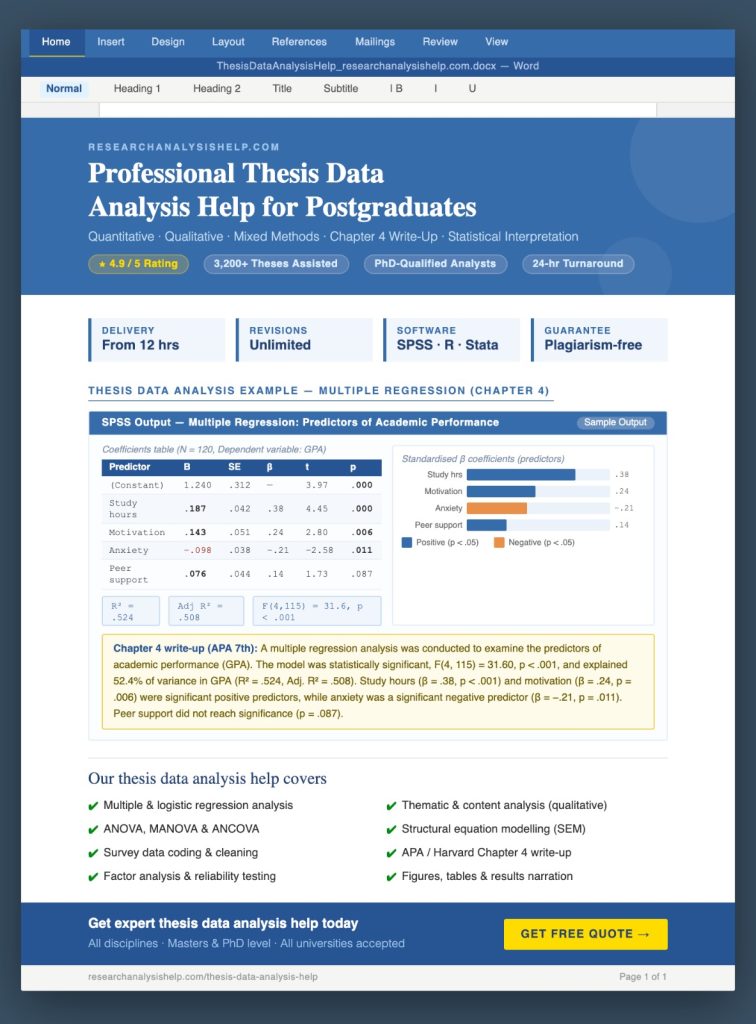
SPSS is useful because it allows students to manage quantitative data, run statistical tests, and produce tables for the write-up. However, many students struggle to interpret SPSS output because the tables include values such as p-values, confidence intervals, standard deviations, coefficients, and significance levels.
Our experts help you interpret SPSS results in clear academic language. For example, instead of simply saying “p = .003,” we help explain what that means for your research question. We also help you decide whether the findings support or reject your hypotheses and how to present them in your analysis and findings chapter.
Qualitative Data Analysis Help for Thematic Analysis and Coding
Qualitative data analysis is the process of interpreting non-numerical data such as interview transcripts, focus group responses, open-ended questionnaire answers, observations, documents, or case study material. Unlike quantitative analysis, which focuses on numbers, qualitative research focuses on meanings, experiences, patterns, and themes.
A common method is thematic analysis. This involves reading through qualitative data, coding key ideas, grouping similar codes, developing themes, and explaining how the themes answer the research question. For example, if your dissertation explores students’ experiences with online learning, your themes may include flexibility, poor internet access, lack of motivation, and improved digital confidence.
ResearchAnalysisHelp.com provides expert help with qualitative data analysis, coding, theme development, interpretation, and write-up. We help you analyse data in a way that is systematic, credible, and connected to your methodology.
Qualitative and Quantitative Data Analysis Dissertation Support
Some studies use qualitative and quantitative analysis together. This is often called mixed-methods research. In this type of data analysis dissertation, you may have questionnaire data for quantitative analysis and interview data for qualitative analysis.
For example, a student studying employee satisfaction may use a survey to measure satisfaction levels and interviews to understand why employees feel satisfied or dissatisfied. The quantitative data may show the level of satisfaction, while the qualitative data explains the reasons behind the numbers.
Our team supports qualitative and quantitative research by helping you connect both types of data. We can help with descriptive statistics, statistical tests, thematic analysis, data integration, and explanation of findings. Whether your study is qualitative or quantitative, or combines both, we tailor the analysis based on your research objectives.
Analyze Data Sets, Raw Data, and Collected Data With Confidence
Many students reach the analysis stage with collected data but no clear plan for what to do next. You may have questionnaire responses, interview transcripts, Excel sheets, SPSS files, secondary data, or survey exports. The problem is not always data collection; the problem is knowing how to analyze data correctly.
Our data analysts help organize raw data, clean the dataset, check missing values, label variables, code responses, and prepare the data for analysis. We also help identify which data analysis methods fit your study.
For example, if your dataset includes age, income, education level, and customer loyalty scores, we can help determine whether descriptive statistics, correlation, regression, or multivariate analysis is suitable. If your data collected from interviews includes repeated opinions or experiences, we can help with coding and thematic analysis.
Consultation for Data Collection and Analysis
Our consultation service is useful when you need a second opinion before committing to a specific analysis process. Sometimes students are unsure whether their methodology fits the research question, whether the sample size is sufficient, or whether the collected data can answer the study objectives.
During consultation, we review your research question, methodology, data collection method, research design, sample size, and available data sets. We then provide step-by-step guidance on the best way to proceed.
For example, if your supervisor asks you to justify your data analysis methods, we can help explain why regression, ANOVA, thematic analysis, descriptive statistics, or another method is appropriate. This support helps you defend your choices and avoid weak or mismatched analysis.
Tailor Thesis Data Analysis Help to Your Specific Needs
Every thesis is different. A nursing dissertation may require patient survey analysis. A business master’s thesis may require regression analysis. A psychology project may require ANOVA and reliability testing. A social sciences dissertation may require thematic analysis of interview data.
That is why ResearchAnalysisHelp.com does not use a one-size-fits-all approach. We tailor our support to your specific needs, university guidelines, supervisor comments, methodology, research question, and data available.
Our support may include full dissertation data analysis, partial analysis, interpretation only, SPSS output review, qualitative coding review, discussion chapter support, or critique of your current analysis. This flexibility makes the service suitable for students at every stage of the research process.
On-Demand Thesis Data Analysis Help When Deadlines Are Close
Research deadlines can be stressful, especially when you are still working on data analysis, interpretation, and write-up. Our on-demand thesis data analysis help is designed for students who need timely academic support without compromising quality.
If your deadline is near, we help you focus on the most important parts of the analysis process. This may include cleaning the dataset, running the required statistical test, producing graphs and tables, interpreting results, and helping you write the findings section.
Our goal is to make the process seamless by helping you move from raw data to clear results. Whether you need quick consultation or detailed support, our team is available to help you stay on track.
Our Track Record in Dissertation Data Analysis Services
ResearchAnalysisHelp.com has built a strong track record in supporting students across different academic levels and research fields. We understand the expectations of academia and the importance of accurate, well-explained analysis.
Our data analysts have experience with social sciences, business, public health, nursing, psychology, education, management, and other fields where qualitative and quantitative analysis are commonly required. We help students produce clear analysis and findings that align with their research question, methodology, and supervisor expectations.
A good thesis is not only about collecting data. It is about showing that you can interpret evidence, critique findings, and explain the meaning of your results in relation to the wider research topic.
Examples of Thesis Data Analysis Help We Provide
A master’s thesis student may have survey data on employee engagement and job satisfaction. We can help clean the data, run descriptive statistics, conduct correlation and regression analysis, interpret the SPSS output, and write the results in academic language.
A Ph.D. student may have interview transcripts from healthcare professionals. We can help with qualitative data analysis, coding, thematic analysis, theme development, and interpretation of findings.
A doctoral student may be working with mixed-methods data. We can help integrate qualitative and quantitative data, explain how both types of findings answer the research question, and support the discussion chapter.
A social science student may have questionnaire responses from students across different universities. We can help select the correct statistical test, produce graphs, interpret quantitative data, and present the findings clearly.
Step-by-Step Guidance Through Every Stage of the Research Process
Our thesis data analysis help can support you through every stage of your research process. This includes topic selection, research question development, methodology planning, data collection, dataset preparation, data analysis, interpretation, write-up, and discussion chapter support.
For students who are still at the planning stage, we can provide guidance on selecting appropriate data analysis methods. For students who already have data, we can help analyse data and interpret the results. For students who have completed the analysis but need a critique, we can review the findings and suggest improvements.
This step-by-step guidance helps you understand what you are doing, why it matters, and how to explain it properly in your dissertation or thesis.
Why Choose ResearchAnalysisHelp.com for Thesis Data Analysis Help?
ResearchAnalysisHelp.com provides expert help for students who need reliable, clear, and practical support with data analysis. Our service is suitable for many students who feel stuck between data collection and final thesis submission.
You should choose us because we:
- Simplify complex statistical and qualitative analysis tasks
- Provide help with SPSS, thematic analysis, regression, ANOVA, and descriptive statistics
- Support qualitative, quantitative, and mixed-methods studies
- Tailor the service based on your research question and methodology
- Help you interpret findings in academic language
- Provide guidance for dissertation, master’s thesis, PhD thesis, and doctoral projects
- Support students across different fields and academic levels
- Help elevate the quality of your analysis and findings chapter
Our aim is to help you achieve a clear, accurate, and well-structured thesis data analysis section.
Get Thesis Data Analysis Help Today
If you are struggling with dissertation data analysis, qualitative data analysis, quantitative analysis, SPSS, statistical analysis, or interpretation of research findings, ResearchAnalysisHelp.com is ready to help.
Share your assignment details, research question, methodology, dataset, supervisor comments, and deadline. Our data analysts will review your needs and provide guidance based on your research. Whether you need full data analysis services or only need help you interpret your findings, we are here to support your research success.
Frequently Asked Questions About Thesis Data Analysis Help
What is thesis data analysis?
Thesis data analysis is the process of examining collected data to answer a research question. It may involve statistical analysis, qualitative data analysis, or both, depending on the research design.
Can you help with dissertation data analysis?
Yes. We provide dissertation data analysis support for qualitative, quantitative, and mixed-methods studies. This includes SPSS, thematic analysis, descriptive statistics, regression, ANOVA, and results write-up.
Do you help with PhD data analysis?
Yes. We provide PhD data analysis help for doctoral and Ph.D. students who need support with complex datasets, qualitative coding, quantitative research, statistical testing, and interpretation.
Can you analyze qualitative data?
Yes. We help analyze qualitative data using coding, thematic analysis, pattern identification, and academic interpretation. We can work with interviews, focus groups, documents, observations, and open-ended questionnaire responses.
Can you help with quantitative data analysis?
Yes. We support quantitative data analysis using tools like SPSS, Excel, R, Stata, or other software depending on your requirements. We assist with descriptive statistics, regression, ANOVA, correlation, and other statistical tests.
Can you help write the analysis and findings chapter?
Yes. We can help you write-up the analysis and findings chapter in clear academic language. We help explain results, present tables and graphs, and connect findings to the research question.
What do I need to send for thesis data analysis help?
You can send your research question, methodology, data collection tool, raw data, dataset, supervisor feedback, required statistical test if provided, university guidelines, and deadline. This helps us tailor the support to your specific needs.